The Art of the Ginger Bug: How We Brew Living Fizz
Step inside our Bangkok brewhouse for a look at the wild ferment that powers every bottle, from raw rhizome to bubbling, living soda.
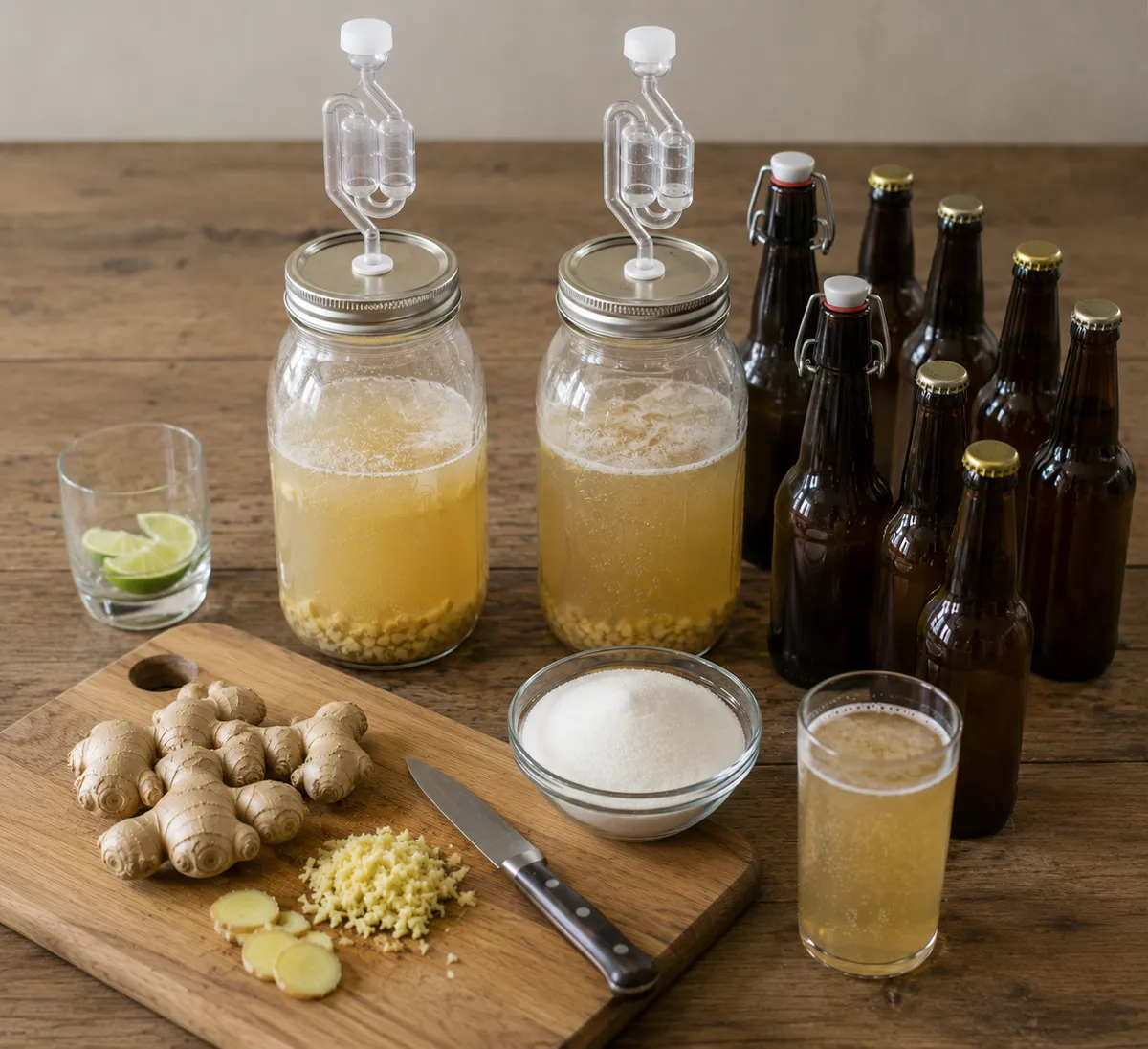
Every bottle of GingerBros begins with something most people throw away: a knob of fresh ginger, a spoon of sugar, and a little patience. We call it the ginger bug, and it is the wild, living heart of our brew. There is no laboratory yeast, no factory carbonation tank, and no flavour concentrate. There is only time, temperature, and the invisible community of microbes that has lived on ginger skin for as long as ginger has grown.
In this piece I want to show what actually happens in our brewhouse: the biology, the daily rhythm, and the judgement calls that no machine can make for us. By the end you will understand not just how we brew, but why a living soda is fundamentally different from anything that comes out of a factory.
What exactly is a ginger bug?
A ginger bug is a natural starter culture, a spontaneous colony of wild yeasts and lactic-acid bacteria that live on the skin of fresh ginger. Feed them sugar and water, and within a week they wake up, multiply, and begin producing carbon dioxide. That CO2 is what gives our fizz its natural sparkle. No injected carbonation, no shortcuts.
Two groups of organisms do most of the work:
- Wild yeasts (largely Saccharomyces and its relatives) convert sugar into a trace of alcohol and a great deal of carbon dioxide. They are the engine of the carbonation.
- Lactic-acid bacteria (mainly Lactobacillus) produce the gentle lactic-acid tang that keeps the brew bright instead of cloying, and they steadily lower the pH into a naturally acidic, self-protecting range.
Together they form a tiny, self-regulating ecosystem: the yeasts and bacteria balance each other, and the rising acidity crowds out spoilage organisms. In short, it is a lot like a sourdough starter, but for soda.
How we build, feed, and keep the bug alive
This is the part most people never see, and it is the single most important habit in the whole operation. A ginger bug is not an ingredient you buy once, it is a culture you keep alive, and a living culture has to be fed.
Building it from scratch (the first week). We start by grating fresh, unpeeled organic ginger into filtered, non-chlorinated water with a measured spoon of white sugar. The skin matters: the wild yeast and bacteria live on it, so we never peel and never use chlorinated tap water, which would kill the very microbes we are trying to wake up.
Feeding it every single day. For a bug to thrive, it needs fresh fuel daily. Each day we "feed" the culture with another spoonful of grated ginger and another spoonful of sugar, and then we stir it well. Both steps matter for a specific reason:
- Adding sugar replenishes the food supply. The microbes eat sugar continuously; starve them and the colony weakens, sours too far, and eventually dies.
- Stirring daily folds in oxygen, which the yeast needs to multiply vigorously in this open, early stage. Stirring also keeps the grated ginger submerged and discourages mould from forming on the surface.
Reading the signs of a healthy bug. Within a few days you should see a rush of fine bubbles when you stir, and smell a bright, sharp, yeasty-gingery aroma. That is the sign the culture is alive and ready to work. A healthy bug always smells clean and peppery, never foul, never rotten.
Keeping the mother culture going between batches. We never let the bug die between brews. Like a sourdough starter, it lives on indefinitely as long as it is fed. When we are brewing daily, it stays at room temperature and is fed every day. To slow it down between batches, we move it to the cold, where its metabolism nearly stops, and feed it about once a week to keep it healthy. Cold is the pause button; warmth and food are the wake-up call.
A ginger bug is less like a recipe and more like a pet. Feed it, stir it, keep it clean, and it will reward you for years.
Day by day in the brewhouse
Once the mother bug is lively, we use it to inoculate a full batch. Our fermentation process is slow on purpose. Here is roughly how a batch moves through our Bangkok brewhouse:
- Day 1: We grate fresh, organic Thai ginger and combine it with filtered, non-chlorinated water, a measured amount of white sugar, fresh lime, and a generous pour of active ginger bug to kick-start fermentation.
- Day 2 to 3: The wild cultures bloom. Tiny bubbles cling to the side of the vessel. The smell turns bright and peppery as the yeast population climbs into the millions.
- Day 4 to 5: Fermentation hits full stride. The ginger bug eats most of the sugar, leaving behind complexity instead of sweetness, while the pH drops into a safe, naturally acidic range.
- Day 6: We taste, adjust, and balance each batch by hand, checking aroma, acidity and carbonation.
- Day 7: Bottling day. The fizz is alive, lightly tart, and unmistakably gingery.
The chemistry of the fizz
Carbonation in a living soda is not pumped in, it is grown. As yeast metabolises sugar through fermentation, it releases carbon dioxide. In a sealed bottle that gas has nowhere to go, so it dissolves back into the liquid under pressure. The result is a fine, persistent bead that feels softer on the tongue than the aggressive sparkle of force-carbonated soda. It is the same principle that puts bubbles in traditional sparkling wine and farmhouse cider.
This is also why a living soda keeps evolving in the bottle: as long as a little sugar and a few active cultures remain, fermentation creeps slowly forward. Keeping the bottle cold slows that process to a crawl, which is why we recommend refrigerating on arrival and why a cold-chain delivery upgrade is available at checkout.
Raw by default, pasteurized by choice
Here is the honest answer, because it is a question we get all the time: do we pasteurize? The answer is: it depends on the bottle, and we make both.
Pasteurization means gently heating a drink to a set temperature to kill microorganisms and extend shelf life. It is a genuinely brilliant food-safety tool. The catch is that heat does not discriminate: the same process that makes a drink shelf-stable also ends the fermentation and removes the live cultures.
So we offer two honest options instead of pretending one size fits all:
- Our raw Ginger Fizz line keeps every live culture intact. It is brighter, more complex, and a little tart, but it must stay refrigerated and is best enjoyed fresh. This is the bottle for people who want the living, gut-friendly version.
- Our pasteurized line is gently heat-treated so it becomes shelf-stable, travel-friendly, and easy to gift. It trades the live cultures for convenience and a longer, more consistent shelf life.
We would rather give you a clear choice between living and shelf-stable than quietly pasteurize everything and call it "raw".
Same natural brew, same real ginger, same care, the only difference is whether we apply heat at the very end. If live cultures are your priority, reach for the raw bottle and keep it cold. If you want something for the cupboard or a long trip, the pasteurized bottle is the practical pick.
The takeaway
Great fizz is not manufactured, it is cultivated. Whether you choose the raw bottle or the pasteurized one, you are tasting a week of patient, living chemistry that started with a fed, stirred, carefully kept ginger bug. That is worth slowing down for.
References & further reading
- 1.Fermentation: how yeast produces carbon dioxide and alcohol, and lactic-acid fermentationEncyclopædia Britannica
- 2.Why is milk pasteurized? Process, temperatures, and food safetyEncyclopædia Britannica
Sources are provided for general education. This article is not medical advice; consult a healthcare professional for personal guidance.
Taste the difference
Real ginger, natural fermentation, live cultures. Get a bottle of GingerBros and try it for yourself.
More from Brewing
 Brewing
Start Your Own Ginger Bug at Home
A beginner-friendly walkthrough to culture your own wild ginger starter, the same idea behind our brew.
Read article Brewing
From Bottle to Soil: Our Sustainability Promise
Recyclable glass, ginger pulp that becomes compost, and the climate cost we are still working on.
Read article